
| (formerly known as Sophronia caenusalis) HERMINIINAE EREBIDAE, NOCTUOIDEA | (donherbisonevans@yahoo.com) and Stella Crossley |
|
| (formerly known as Sophronia caenusalis) HERMINIINAE EREBIDAE, NOCTUOIDEA | (donherbisonevans@yahoo.com) and Stella Crossley |
This Caterpillar feeds on dead leaves, and is a pest in the tropics in roofs consisting of dried palm leaves.
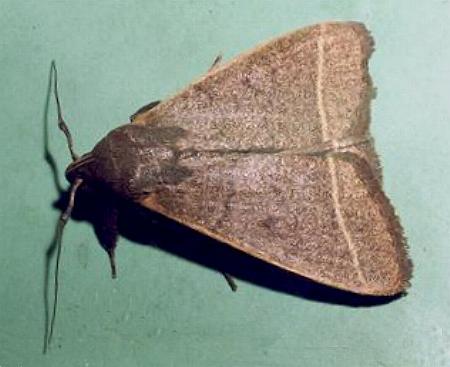
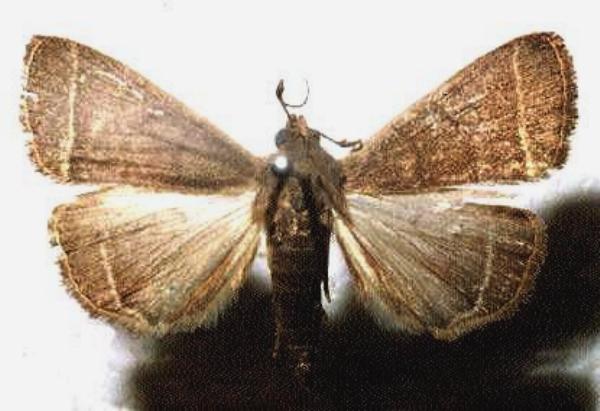
The adult moth has a wing span of about 3 cms. It is brown with a pale line across the margin of each forewing, and a curved white line across the margin of each hindwing.
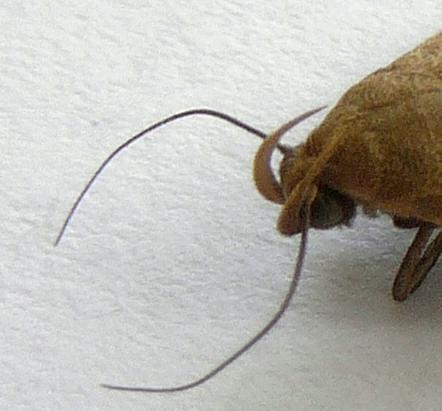
The moths have long labial palps which are held curved up over the head. The males have a tuft of scales part way along each antenna.
This species has been reported in countries across Asia and the Pacific (there listed as Simplicia cornicalis), in:
and in eastern Australia in:

Sophronia caeneusalis Walker 1859, was placed in synonymy with Phalaria cornicalis Fabricius 1794, by Jeremy Daniel Holloway in 2008 after examination of the genitalia of the Phalaria cornicalis type in Copenhagen.
This appears weird, as Simplicia caeneusalis has a clear submarinal forewing white line, where Nodaria cornicalis has no such line.
Further reading;
Francis Walker,
Catalogue of Lepidoptera Heterocera,
List of the Specimens of Lepidopterous Insects in the Collection of the British Museum,
Part 16 (1858), p. 94.
 caterpillar |  butterflies |  Lepidoptera |  moths |  caterpillar |
(updated 7 April 2011, 30 May 2014, 9 April 2021)