
| Dark Cerulean (previously known as Lycaena aleuas) POLYOMMATINI, POLYOMMATINAE, LYCAENIDAE, PAPILIONOIDEA | (donherbisonevans@yahoo.com) and Stella Crossley |
|
| Dark Cerulean (previously known as Lycaena aleuas) POLYOMMATINI, POLYOMMATINAE, LYCAENIDAE, PAPILIONOIDEA | (donherbisonevans@yahoo.com) and Stella Crossley |
The Caterpillars of this species are green and covered in fine hairs. The caterpillars have been found feeding on :

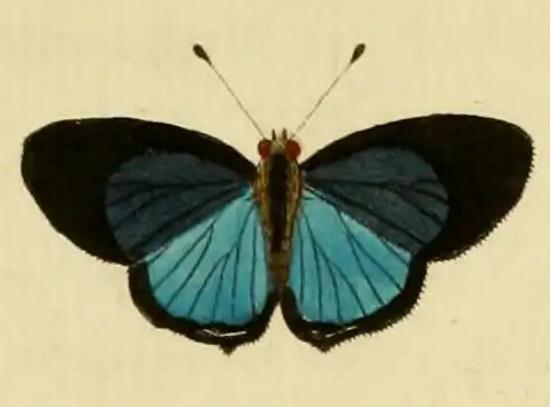
The forewings of the males are blue on top with a large black area around the wingtip. The hindwings are blue with a pale area along the hind margin.

The females on top are dark brown with some blue areas.

Underneath, both sexes are fawn with arcs of white markings under all four wings. Each hindwings also each have a orange-ringed black spot underneath beside the short white-tipped black tail.
Various subspecies occur across Asia, including
and in particular subspecies bochus has been found on
which is an Australian island, but the species has not actually been found on mainland Australia.
Further reading :
Caspar Stoll,
Papillons exotiques,
in Pieter Cramer:
Uitlandsche kapellen, voorkomende in de drie waereld,
Volume 4 (1782), p. 210, and also
Plate 391, figs C, D.
 caterpillar |  butterflies |  Lepidoptera |  moths |  caterpillar |
(written 25 May 2026, updated 31 August 2026)