
| (formerly known as Lomera albifrons) PSYCHIDAE, TINEOIDEA | (donherbisonevans@yahoo.com) and Stella Crossley |
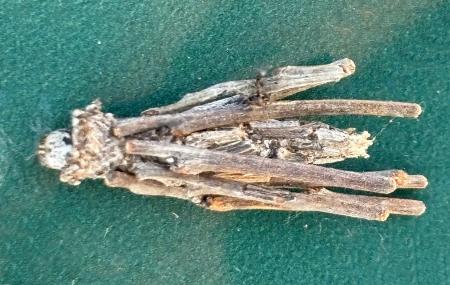
caterpillar still attaching sticks to its case
(Photo: courtesy of
Christine Rand,
Nullarbor Wilderness Protection Area, South Australia)
|
| (formerly known as Lomera albifrons) PSYCHIDAE, TINEOIDEA | (donherbisonevans@yahoo.com) and Stella Crossley |
caterpillar still attaching sticks to its case
(Photo: courtesy of
Christine Rand,
Nullarbor Wilderness Protection Area, South Australia)
These Caterpillars live and pupate in a silken case. to which they attach twigs parallel to the axis of the case. The mature caterpillar has a case of length 3 to 4 cms. Sometimes one or two twigs are longer than the others, with a length up to 5 cms.
The caterpillars normally only protrude the head and thorax out of the case, as these are covered in a hard skin that is coloured in a light and dark brown pattern. The soft abdomen is kept inside the protective case.
The caterpillars have been found feeding on plants in several families including
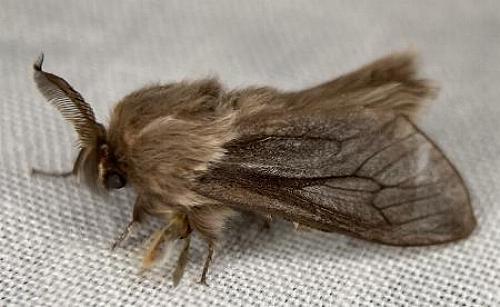
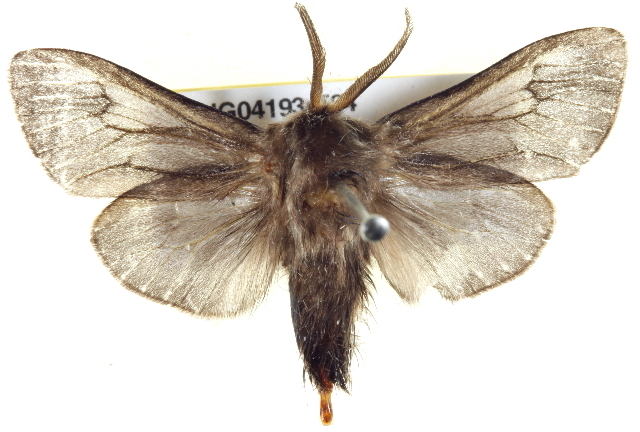
The adult male is hairy and brown, with translucent grey wings that have black veins. His wingspan is about 2.5 cms.
The female is wingless. She looks like a tubby off-white grub, with a brown head. She has a length of about 4 cms. She stays inside the case, and is fertilised by a male inserting the tip of his abdomen into the anal end of the case.
The species has been found west of the Great Divide, in central and south-west Australia, including
The caterpilars are attacked by a variety of parasitic flies and wasps.
Further reading :
Ethan P. Beaver, Thomas Sobczyk, Jonathan Wei Soong, Mengjie Jin,
Claire Yang, Elizabeth Broady, Jesse Wallace, Diana Hartley,
James A. Nicholls, & Andreas Zwick,
Systematic revision of the Bagworm Moth genus Clania Walker 1855
(Lepidoptera, Psychidae, Oiketicinae) with thirty-four new species,
Zootaxa, Magnolia Press
Volume 5901 (2026), pp. 54-56.
Charles Swinhoe,
Sphinges and Bombyces,
Catalogue of Eastern and Australian Lepidoptera Heterocera
in the Collection of the Oxford University Museum,
Clarendon Press, Part 1 (1892), p. 225, No. 1065.
 caterpillar |  butterflies |  Lepidoptera |  moths |  caterpillar |
(written 18 November 2026)